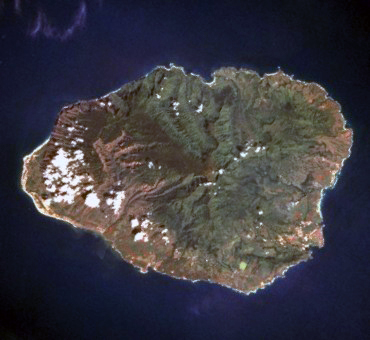
This version assumes no contributed radios, switches, batteries, or antennas. The shelf inventory is a separate asset and is not subtracted here. Four town hubs (Hāʻena, Hanalei, Princeville, Kīlauea) plus one ridge relay, because the North Shore usually needs an extra hop. A survey can drop the relay. Each town hub gets one BLiNQ FW-300i phone radio, covering about 180° of that town. Smaller solar nodes for the pockets that face misses are a later phase and are not in this price. A Verizon, AT&T, or T-Mobile radio, and a radio on every house, are still later purchases. Turn on Gap fill to add the eight pockets, $527,087 to build and $106,723 a year. Turn on Whole island to add the other coastal towns, $1,086,901 to build and $177,581 a year.
Capital cost to build
$375,829
New equipment, solar and batteries, generators, freight, labor, 15% overhead, Kauaʻi GET, and an 8% materials contingency.
Annual operating cost
$80,419
Includes an on-call roster, one outage week, quarterly maintenance, admin, insurance, Starlink service, generator exercise fuel, a spares reserve, and site access if the roofs are not donated.
Where the build money goes
Ubiquiti airFiber 5XHD on 5 GHz for the backbone, with 30 dBi dishes. It stays up in rain when a clean channel is available, and it is the radio a working fixed-wireless builder would still use for most links. Ubiquiti’s newer Wave MLO5 can bond more 5 GHz spectrum for multi-gigabit speed and also does not fade in rain, but this pilot does not need that speed and wide channels are harder to find. Phones do not join that backbone. Each town hub gets one BLiNQ FW-300i on Band 48, the shared CBRS band, covering about 180° of that town, so a phone that installs this network’s profile has LTE there. Town hubs get seven EG4 5.12 kWh batteries online so the phone radio stays inside 72 hours at its published maximum draw. The ridge relay stays at four. Every site keeps a hot spare, 3.2 kW of solar, and a propane generator. Starlink Mini is the off-island path at two hubs. Messages use current RAK WisMesh gateways.
Radios, mesh, and compute$58,919
Solar, batteries, and generators$93,849
Shipping to Kauaʻi$18,000
Drone survey, lift, and permits$27,521
Labor$100,640
Overhead and margin$44,839
Kauaʻi GET$16,198
Materials contingency$15,863
Radios, mesh, and compute$58,919
Ubiquiti airFiber 5XHD radiosListed price
8 radios, two per hop, for 4 links. Ubiquiti’s store lists the AF-5XHD at $429. 5 GHz keeps working in heavy rain. 60 GHz does not.
Ubiquiti store, airFiber 5XHD8 × $429$3,432
Spare airFiber radiosListed price
Two spares on the shelf the day the corridor is built, so a failed radio is not a reorder from the mainland.
Ubiquiti store, airFiber 5XHD2 × $429$858
Ubiquiti RocketDish 30 dBiListed price
One RD-5G30 per radio. A distributor lists it at $182.52, rounded here.
NewTech Industries, RD-5G308 × $183$1,464
airFiber dish mount kitsAllowance
The RocketDish needs an airFiber X mount to hold a 5XHD. Allowance until that SKU is on the order.
8 × $99$792
RAK WisMesh Ethernet gatewaysListed price
One current Meshtastic gateway at each powered site. Rokland lists the PoE build at $114.97.
Rokland, WisMesh Ethernet gateway5 × $115$575
Community mesh radiosAllowance
20 current WisMesh-class handhelds, about five per town, for the short-message layer.
20 × $65$1,300
Site routersAllowance
One current MikroTik RB5009-class router at each powered site.
5 × $250$1,250
Hub computersAllowance
Four fanless edge PCs, one per town hub, to hold the cached status note. The relay does not get one.
4 × $650$2,600
Outdoor PoE switchesAllowance
One small PoE switch at each powered site. The phone radio runs on the 48 volt battery bus, not on this switch.
5 × $200$1,000
BLiNQ FW-300i phone radiosListed price
One at each town hub, none at the ridge relay. BLiNQ’s shop lists the Band 48 model at $8,000, with the mount and a 48 volt jumper. It is one box with about 180° of coverage, so it faces the town instead of three separate sectors. BLiNQ lists up to 53 dBm EIRP per sector; a Category B grant is capped at 47 dBm per 10 MHz, and the grant sets the power. Maximum draw is 180 watts, off the 48 volt battery bus. The map still shades the town, not a measured contour. A phone uses this after it installs a profile. It stays a Band 48 network, not Verizon, AT&T, or T-Mobile.
BLiNQ shop, FW-300i Band 484 × $8,000$32,000
Spare phone radioListed price
One spare FW-300i, so a failed town radio is a swap and not a mainland reorder.
BLiNQ shop, FW-300i Band 481 × $8,000$8,000
Embedded core licensesListed price
BLiNQ’s embedded EPC license is $750 and runs inside one base station, so the town does not need a separate core server. Five licenses: four live radios and the spare.
BLiNQ shop, embedded EPC license5 × $750$3,750
First 100 phone profilesAllowance
SIM or eSIM cards so the first neighbors can join the Band 48 network. The core license is a separate line. No single catalog price covers the card pack. Allowance, not a carrier plan.
1 × $1,500$1,500
Starlink Mini kitsListed price
Two kits, at Hanalei and Princeville. Starlink lists the Mini from $199. The dish stays inside the power budget. Community outlets are limited before the dish or the radios.
Starlink Mini2 × $199$398
Solar, batteries, and generators$93,849
EG4 48V 100Ah LiFePO4 batteriesListed price
Four online at the ridge relay, seven online at each town hub. Seven packs are 35.84 kWh nameplate, about 29 kWh usable at 80% depth of discharge. The phone radio’s published maximum is 180 watts, so a town hub is about 380 watts and about 27 kWh over 72 hours. That fits the seven-pack bank. The ridge relay stays near 200 watts and keeps four packs.
SanTan Solar, EG4 LifePower4 V232 × $1,471$47,072
Hot-swap spare batteriesListed price
One extra 5.12 kWh pack at each site, stored charged. A weak online pack can be unbolted and this spare bolted in while the others keep the hub up. At a town hub, six packs remain until the spare is in, about 25 kWh usable. At the ridge relay, three remain, about 12 kWh.
SanTan Solar, EG4 LifePower4 V25 × $1,471$7,355
Victron Lynx DistributorListed price
One fused DC bus at the ridge relay, two at each town hub. Two distributors give eight fuse positions. Seven packs sit online, and the spare can take the eighth during a swap. Current Connected lists the M10 at $232.90.
Current Connected, Lynx Distributor M109 × $233$2,097
Battery fusesAllowance
Four MEGA fuses plus a spare at each site. The Lynx ships without fuses.
5 × $125$625
Victron MultiPlus-II 48/5000Listed price
One 120V UL inverter/charger per site. 4,000 watts continuous and a 70 amp charger, so the hub can run a charging station and still take a generator. The charger is limited to about 2.5 kW so it stays inside the generator’s propane rating. Current Connected lists it at $1,458.60.
Current Connected, MultiPlus-II 48/5000 120V5 × $1,459$7,295
Victron SmartSolar MPPT 250/70Listed price
One charge controller per site. Eight 400W panels are about 57 amps while charging, inside the 70 amp limit. EXPLORIST.life lists it at $502.35.
EXPLORIST.life, SmartSolar MPPT 250/705 × $502$2,510
400W solar modulesAllowance
Eight modules per site, 3.2 kW. On a clear day that is on the order of 9–10 kWh, enough to run the hub and put charge back in the bank. After a storm the yield drops, which is why the generator is in the budget. Retail allowance.
40 × $210$8,400
Dual-fuel inverter generatorsListed price
One Champion 4500-watt inverter generator per site, model 201319, so no one has to haul a generator across the bridge during the storm. Propane is the storm fuel because it stores. Gasoline is the second fuel. SuperGen lists it at $959. Propane running output is about 3,150 watts.
SuperGen, Champion 2013195 × $959$4,795
Propane cacheAllowance
Four 20-pound tanks at each site, bought on Kauaʻi. One tank is about one full recharge of the online bank. Four tanks cover several cloudy days of top-ups. Tank plus the first fill.
20 × $85$1,700
Racks, racking, generator inletAllowance
Rack space for the online batteries, including seven packs at each town hub, a shelf for the spare, eight-panel racking, generator inlet, propane cage, surge protection, conduit, and grounding. Per-site allowance, not a quote.
5 × $2,400$12,000
Shipping to Kauaʻi$18,000
Freight to KauaʻiAllowance
About four tons once the battery racks, eight-panel arrays, and generators are included. Ocean freight to Nāwiliwili, then a smaller shuttle past the Hanalei bridge, which a full box truck may not cross. Propane tanks are bought on island and are not in this weight.
1 × $18,000$18,000
Drone survey, lift, and permits$27,521
Survey drone kitListed price
DJI Mavic 3 Enterprise with spare batteries and a zoom camera, bought rather than rented, so later roof and path checks use the same kit. UAV Coach lists a battery kit at $5,721.
UAV Coach, Mavic 3 Enterprise battery kit1 × $5,721$5,721
Drone path surveyAllowance
Four days with a Part 107 pilot to check line of sight on each hop and the spare ridge, including a weather hold. Day rate allowance, not an electrician hour.
4 × $1,800$7,200
Boom liftAllowance
Lift rental and delivery to the North Shore for roof mounts the drone cannot install.
1 × $3,000$3,000
PermitsAllowance
Electrical and solar permits for a 3.2 kW array and a generator at each site, the four phone-radio mounts, plus a coastal Special Management Area allowance where Hāʻena or Hanalei sites fall inside it.
1 × $10,000$10,000
CBRS installer registrationAllowance
A certified professional installer has to register each Category B radio with a spectrum system before it can transmit. Allowance for four radios. Not a vendor quote.
1 × $1,600$1,600
Labor$100,640
Install and alignmentAllowance
400 hours at $185. Two people for five days at each of five sites: battery rack, eight-panel array, generator inlet, radio alignment, and the drive past Princeville.
400 × $185$74,000
Phone-radio installAllowance
64 hours at $185. Two people for one day at each town hub to mount the FW-300i, aim its 180° face at the town, land it on the 48 volt bus, and confirm a handset joins.
64 × $185$11,840
RF and electrical designAllowance
80 hours at $185 for the link budget, the Band 48 sector aim, the one-line with the generator inlet and hot-swap bus, and permit drawings.
80 × $185$14,800
Each year$80,419
Starlink Roam 300GBListed price
Two dishes at $80 a month. Starlink’s published Roam 300GB plan.
Starlink service plans$1,920
Spectrum access systemListed price
Key Bridge Wireless lists $500 a month, and that base fee includes the first 200 radios. Four phone radios fit inside it. Google is not taking new SAS customers. The radios cannot legally transmit on Band 48 without a grant.
Key Bridge Wireless, June 16, 2026$6,000
Maintenance laborAllowance
Four quarterly service visits, 48 hours at the $185 bill rate. Storm response is the on-call roster and the outage week below, not this line.
$8,880
Site accessAllowance
$200 a month at five sites if the roof or yard is not donated. Drop this line if hosts give the location.
$12,000
Equipment insuranceAllowance
Inland-marine style allowance for the installed gear, including the battery racks and generators. Not a broker quote.
$3,600
Admin and bookkeepingAllowance
About four hours a month to pay bills and track spares. Updating the status note during an outage is the outage-week line.
$4,800
On-call rosterAllowance
Two local people, primary and backup, alternating weeks, so someone can reach the North Shore. $60 a day for the person carrying the phone, 365 days. That is availability, not the repair rate. They answer, start a generator, swap a battery, and call the backup if they cannot get there.
$21,900
Outage operationsAllowance
One week of active response in the year: two people, eight hours a day, 80 hours at the $185 bill rate. They check each site, run the generator if the array is down, swap a pack if one fails, and keep the cached status note current. A longer outage adds hours beyond this allowance.
$14,800
Generator exercise fuelAllowance
A short monthly run at each site so the propane generator starts when the storm actually comes. Allowance for fuel, not a delivery contract.
$900
Spares reserveAllowance
Annual set-aside toward a replacement radio, a battery, or a generator hose. The batteries themselves are warrantied for about 10 years.
$2,000
Kauaʻi GET
$3,619
Prices checked October 2026. Listed lines are the published price rounded to the dollar. Allowances are not vendor quotes. Overhead is 15% of equipment, power, freight, and labor. Kauaʻi general excise tax is 4.5% charged on the tax itself (about 4.71%). The materials contingency is $15,863. Install labor is priced at $185 an hour. That is a Kauaʻi contractor bill rate for a licensed electrician and a helper, above the roughly $47 journey-worker wage in local job postings. It is not the $89.71 prevailing-wage total, which is a wage-plus-fringe figure for covered public work, not a bill rate. The earlier $150 rate did not cover a four-day site or the North Shore shuttle. The backbone is unlicensed 5 GHz, so it does not depend on a 6 GHz frequency coordinator.